But not to worry, the OMA/OSQA blog posts will all remain accessible online and if you want to only see OMA or OSQA related blog posts in the SCARC blog, you can!
Activism comes in many forms. This was made clear to me as I was working on completing the finding aid for the Corvallis Lesbian Avengers Collection, part of the Oregon State Queer Archives. The Lesbian Avengers were a direct-action lesbian activism group active throughout the 1990s, perhaps most famous for their fire-eating demonstrations. Inspired by the deaths by firebombing of Hattie Mae Cohen and Brian Mock, both members of the LGBT community, the Lesbian Avengers decided to make the fire their own, to consume it along with their fear, and be bold and brazen, despite the dangers.
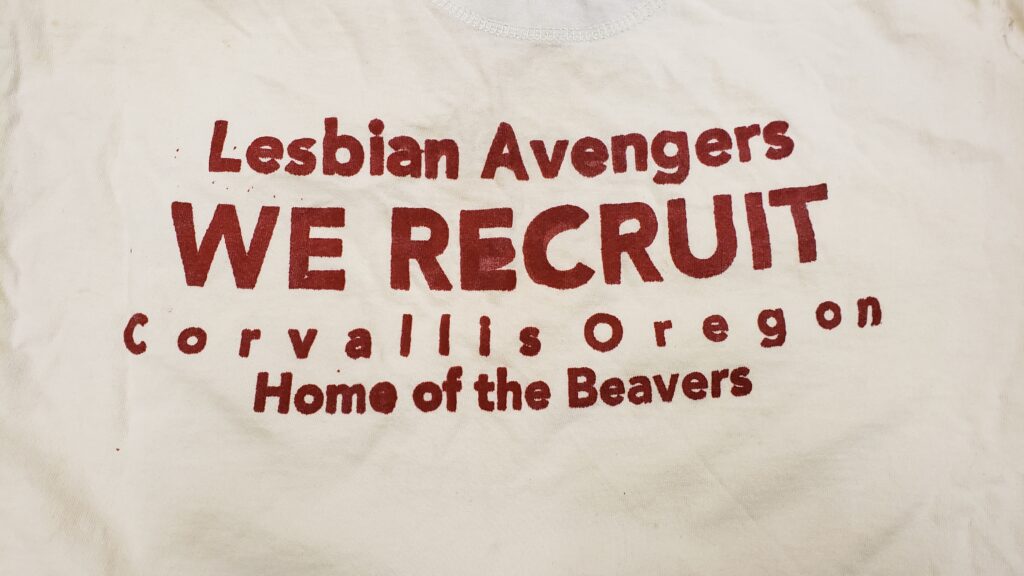
Given the original, NYC Lesbian Avengers’ proclivity for metaphor, it is no surprise that our own Corvallis, OR chapter was also drawn to art and metaphor as part of their own activism. While the Corvallis Lesbian Avengers collection includes a variety of material, including photo albums, scrapbooks, t-shirts, and an annotated calendar, I would like to focus on the Necessary Friction Zine, produced by the Lesbian Avengers. These zines are an eclectic mix of material, including calls to action, recruitment material, educational campaigns, member updates, art, and creative writing. It is this creative writing that I would like to draw attention to. Often poetry, sometimes prose, sometimes erotic, and always provocative, the writing contained within the Necessary Friction zine is a window into the more affective parts of the Lesbian Avengers – their lusts, their hopes, their loves, and their rage. This outpouring of emotion and vulnerability was in and of itself, a form of activism. A refusal to be silenced or forgotten. In the spirit of that, let’s dive in.
The first piece in the first issue of Necessary Friction is Queen of Wands, by Julie. This piece is an intense personal erotic BDSM narrative, unflinching in its realness. At a time when lesbians could be quietly killed for the crime of existence, to claim lesbian sexuality, especially kink was an incredibly powerful act. Sex and kink were a part of queerness for many members of the Avengers, and they were unafraid to claim it. This is where the Lesbian Avengers’ strength lied: a refusal to be shamed.
Bravery takes many forms. In this personal narrative, What Caught my Eye, by Amy, Amy recounts a particular encounter with a lover, in which they, joyous at being reunited after a long time apart, kiss brazenly in the street, in spite of jeers and hatred, before retreating to the safety of Amy’s home. This particular piece illustrates the complex emotions that go into activism. Where there is bravery, there is always fear. And where there is pride and openness, there is the threat of danger. The ability to share such complications and vulnerabilities is one of the strengths of the zines, and what made them a valuable tool for the Avengers to communicate, as well as a valuable tool by which we can understand them today.
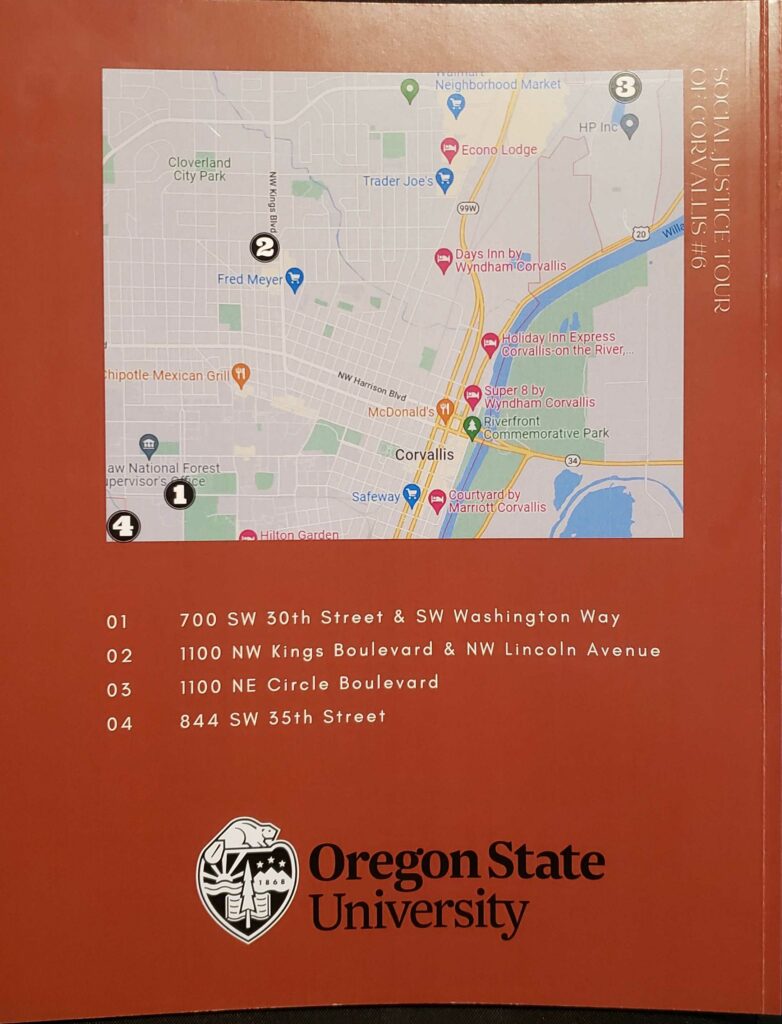
For their sixth tour, the OMA collaborated with the Ethnic Studies 553: Ethnohistory Methodology course taught by Professor Natchee Barnd. As in previous years, the students came to the archives to review OMA and OSQA materials, and visited the Benton County Historical Society archives as well, to conduct research regarding the histories of the OSU and Corvallis area’s traditionally marginalized communities. The 6 students researched and wrote 1-2 stories each, featuring various OSU and Corvallis area histories, and they complied them into a tour guidebook.
On Friday December 3rd, a group gathered to attend an end of term tour given by the class. There were 10 stories total, which included but are not limited to, a view of campus from the perspective of White Oak, the importance of a local OSU community garden, the experiences of two Indian women who earned their Masters degrees at OSU in the 1940s, and the use of blackface in campus activities.
It was just over 18 months ago that the OMA put the final touches on the exhibit “Legacy of an Oregonian Photographer: the Chuck Williams Photographic Collection.” We decided to leave the exhibit in place with the hope that someday we would be able to reopen so it could be seen – and now that time has finally come! We tidied it up a bit, re-printed some pieces, and now it’s ready for viewing!
The exhibit is located on the 5th floor of the Valley Library, in the SCARC exhibit gallery. The space is open Monday – Friday 10am-4pm (subject to change based on staff availability).
Mexicanos in Oregon: Improving access to their stories through metadata
Hello, readers! I’m Valeria Dávila Gronros, the 2019-2021 Fellow in the Diversity Scholars Program (DSP) at the OSULP.
As a DSP Fellow, I’ve been collaborating on projects with different library departments, especially in projects involving collection management, development, and accessibility. As a native Spanish-speaking Latina, I was keenly interested in improving accessibility through translation, helping make library materials available in Spanish. Fortunately, in October 2020, the opportunity emerged for me to start working on an exciting, bilingual oral histories project with the Special Collections and Archives Research Center Oregon Multicultural Archives (OMA), aimed at improving discoverability of and access to the 25 oral histories in the Erlinda Gonzales-Berry Papers (1943-2010) collection.
The Erlinda Gonzales-Berry Collection
Erlinda Gonzales-Berry chaired the Oregon State University Ethnic Studies Department from 1997 until 2007, and the materials in this collection reunite her extensive research on Mexican immigration to Oregon for “Mexicanos in Oregon: Their Stories, Their Lives” (2010), a book she co-authored with her peer Marcela Mendoza and published through the OSU Press. In addition to the published book, chapter drafts, correspondence, newspaper clippings, photographs, and other paper-based materials, the collection also includes 34 audiocassettes of 25 interviews with Mexican immigrants and children of early Mexican migrant settlers in Oregon, all of which have been digitized. Of note, among the interviewees are the Mexican María Damaris Silva, who at the time of the interview had served as a community organizer in Oregon and California, and the Chicano John Little, who served as the first Director of the Migrant Valley League.
Figure 1. Screenshot of Erlinda Gonzales-Berry Papers finding aid.
The Oral Histories Project
It all started in Spring 2020, when the Oregon Multicultural Archives collaborated with students in the Ethnic Studies course 416/516 Migrant Health at the OSU on creating interview summaries, biographies, and historical context essays for the oral histories interviews in this collection, in Spanish and English, as most of the interviews are in Spanish.
There were less students than interviews, so some interviews remained incomplete until I started working on the project some months later, in the Fall. My work consisted of reviewing, amending, and occasionally, also translating the metadata created by the students from/to English or Spanish, as well as creating the full descriptive metadata where missing. The aim of this work was to add this metadata to the finding aid to make these stories more easily discoverable and accessible for research.
Working Remotely
For me to work on the project remotely, my supervisor, Natalia Fernández, shared a Google Drive folder with me containing 25 subfolders, one per interview. Each subfolder contained a Google Doc with sections for the summary, bio, and historical context, plus the audio file/s. While the majority of the interviews had these sections complete, others were partially complete or empty.
Figure 2. A peak at the six interviews needing full metadata at different stages of completion.
Since the situation was different for each interview, my first step was grouping them according to their state to be able to organize my work and make priorities, since we wanted to update the finding aid on a rolling basis, as the metadata became available, instead of waiting until I completed the project to do so. For this reason, I decided to start with the oral history interviews that only needed reviewing and amending, as they were the most quantius and the ones I would complete faster. I then continued with the ones that, in addition to the revision and amending needed translation, and, finally, with those in need of the full descriptive metadata, as they would take more time than the rest to be completed. From the total 25 interviews, I reviewed, amended, and, in some cases, translated 19 of them, and created summaries and biographies in English and Spanish for the remaining 6.
Outreach
As a daughter of immigrants, and an international student, this was a meaningful project for me and one I’m thankful to have taken part in. Wanting for users and the library and archives community to become aware of the existence of these materials and of these improvements, on April 15th I presented a poster about the project at the Association of Moving Image Archivists (AMIA) Spring Conference 2021.
Figure 3. Poster presented at AMIA Spring Conference 2021.
The recording for the poster presentation can be accessed here:
In spring term 2020, the OMA collaborated with the OSU course Ethnic Studies 416/516 Migrant Health on an oral history assignment. The students listened to the oral history interviews from the Erlinda Gonzales-Berry Papers to create: interviewee bios, interview summaries, and historical context essays – all of these components are in both Spanish and English as the majority of the interviews are in Spanish.
The oral histories were conducted as part of Gonzales-Berry’s research for the book Mexicanos in Oregon: Their Stories, Their Lives. The set of interviews features over two dozen interviewees – bios and summaries are included in the finding aid. Below are the historical context essays the students wrote (note: these essays were left as written by the students for the purposes of showcasing their work as well as providing additional context for the interviews; the text was not fact checked):
Entrevistado/Interviewee: Armando Álvarez
Contexto histórico: La historia de inmigración de Armando Álvarez es similar a la de muchos en todo el país. Armando llegó a los 15 años y pizcó fresas, y en el momento de esta entrevista fue en 2003 y estaba trabajando en la minería. En 2003, hubo una caída del total de inmigrantes entrantes, aunque es importante tener en cuenta que los inmigrantes indocumentados no están incluidos en estos datos. Esto incluye individuos con residencia legal permanente, estudiantes extranjeros y trabajadores temporales (Meyers & Yau, 2017). Armando menciona la diferencia en el tratamiento basado en el origen étnico, específicamente en los centros de trabajo notó la diferencia en quién fue contratado y quién no. Los latinos informaron haber sido discriminados en contra de solicitar empleos, salarios inadecuados o insultos raciales o étnicos experimentados (Neel, 2017). En el pasado, Oregón y el gobierno de los Estados Unidos han trabajado juntos en el tema de la inmigración, como con la “Operación Espalda Mojada”, que involucró deportaciones masivas de personas indocumentadas (Bussel, 2008). Con el paso del tiempo, Oregón comenzó el proceso de convertirse en un estado santuario en 1977 (Wilson, 2018). Esto esencialmente significa que Oregón no usa sus recursos para hacer cumplir la ley federal sobre inmigración (Wilson, 2018). En todo el estado, la formación de organizaciones como PCUN contrastaba con lo que sucedía en el país (Bussel, 2008). Sin embargo, Oregón tiene una historia de reforzar la supremacía blanca a través de sus leyes (Bussel, 2008). Durante la administración Trump ha habido un aumento en la retórica negativa de inmigración, deportaciones masivas y una mayor seguridad fronteriza (Wilson, 2018). El aumento de inmigrantes a Oregón se ha debido a diversos factores, como los empleos agrícolas, la menor demanda de otros tipos de empleos en otros estados y las redes de servicios existentes (Bussel, 2008). Si bien hay un aumento de la inmigración en el estado, grupos anti-inmigración han iniciado esfuerzos para derogar el estado de santuario de Oregón. Sin embargo, esta medida no llegó a la votación de 2018 (Wilson, 2018).
Historic context: Armando Alvarez’s immigration story is similar to many across the country. Armando came at age 15 and picked strawberries, and at the time of this interview, which was 2003, he had been working in mining. In 2003, there was a drop of overall incoming immigrants, although it is important to note that undocumented immigrants are not included in this data. This includes individuals with permanent legal residency, foreign students, and temporary workers (Meyers & Yau, 2017). Armando mentions the difference in treatment based on ethnicity, specifically how in job centers he noticed the difference in who got hired and who did not. Latinos have reported being discriminated against applying for jobs, inadequate pay, or experienced racial or ethnic slurs (Neel, 2017). In the past, Oregon and the United States government have worked together on the topic of immigration such as with “Operation Wetback” which involved mass deportations of undocumented people (Bussel, 2008). As time went on, Oregon began the process of becoming a sanctuary state in 1977 (Wilson, 2018). This essentially means that Oregon does not use its resources to enforce federal law on immigration (Wilson, 2018). Throughout the state the formation of organizations like PCUN contrasted with what was happening in the country (Bussel, 2008). However, Oregon does have a history of reinforcing white supremacy through its laws (Bussel, 2008). During the Trump administration there has been an increase in negative immigration rhetoric, mass deportations, and increased border security (Wilson, 2018). The increase of immigrants to Oregon is due to varying factors like agricultural jobs, less demand of other types of jobs in other states, and existing networks of services (Bussel, 2008). While there is an increase of immigration in the state, anti-immigrant groups have engaged in efforts to repeal Oregon’s sanctuary status. Nonetheless, this measure did not make it to the 2018 ballot (Wilson, 2018).
Referencias/References:
Bussel, R., & University of Oregon. (2008). La experiencia de los inmigrantes de Oregón: estudios, análisis y recomendaciones de un grupo de investigadores de la Universidad de Oregón. Eugene, Or.]: University of Oregon.
Wilson, C. (2018, May 31). 30 Years After Its Passing, Oregon’s ‘Sanctuary State’ Law Serves as A Model for Others.
Entrevistado/Interviewee: Marco Antonio Chávez
Contexto histórico:Marco llegó a los Estados Unidos en el año 1988 cuando tenía 8 años. Durante este tiempo, el gobierno de Oregón puso en su constitución del estado que no habría descriminacion contra nadie. Esto se significaba que los estudiantes de color tenían que recibir la misma educación y tratamiento que lo otros niños. En este tiempo, también había un grupo de movimiento social que ayudaba a los migrantes llamado PCUN. En este año, 1,300 inmigrantes solicitaron amnistía en virtud de la legislación de 1986 y 98% de estas aplicaciones fueron aceptadas. Para los inmigrantes esto fue bueno porque lograron estar en los Estados Unidos ilegalmente. Durante este tiempo, la comunidad latina contribuyó a Oregon por ser el 2.5 por ciento de las población. Esto se acumula a 65,000 personas. Oregon tuvo una recesión durante este tiempo y los agricultores empezaron a depender mucho de los latinos para mantener sus terrenos. Los agricultores empezaron a traer inmigrantes de México porque ellos trabajaban por salarios bajos y no se quejaban. A causa de todo esto, el gobierno de los Estados Unidos aprobó la ley de Reforma y Control de Inmigración y el Programa Especial de Trabajadores Agrícolas. Esta ley permitió que los inmigrantes que han estado en los Estados Unidos desde 1982 se conviertan en ciudadanos. Pero esta ley también tenía sus defectos: no permitía a los agricultores contratar trabajadores indocumentados. Aquí en Oregon, 23,736 hispanos recibieron residencia permanente debajo del Programa Especial de Trabajadores Agrícolas.
Historical context: Marco came to the United States in 1988 when he was 8 years old. During this time the Oregon government put in its state constitution that there would be no discrimination against anyone. This meant that students of color had to receive the same education and treatment as other children. At this time there was also a social movement organization that helped immigrants called PCUN. This year, 1,300 immigrants applied for amnesty under the 1986 legislation, and 98% of these applications were accepted. For immigrants, this was good because they managed to be in the United States illegally. During this time the Latino community contributed to Oregon by being 2.5 percent of the population. This accumulates to be 65,000 people. Oregon had a recession during this time and farmers began to become very dependent on Latinos to help maintain their land. The farmers began to seek immigrants from Mexico because they worked for low wages and did not complain. Due to all of this, the United States government passed the Immigration Reform and Control Act and the Special Program for Agricultural Workers. This law allowed immigrants who have been in the United States since 1982 to become citizens. This law also had its flaws: it do not allow farmers to hire undocumented workers. Here in Oregon 23,736 Hispanics received permanent residence under the Special Farmworker Program.
Referencias/References:
Garcia, Jerry. “Latinos in Oregon (Essay).” The Oregon Encyclopedia, 10 July 2019, oregonencyclopedia.org/articles/hispanics_in_oregon/#.XsDArxNKhQI. “History of PCUN.” PCUN, 5 June 2018, pcun.org/about-pcun/history-of-pcun/
Entrevistado/Interviewee: José García
Contexto histórico:En el año que José García emigró hacia los Estados Unidos la patrulla fronteriza todavía no había sido aumentada, no hasta la presidencia de Bush. No fue hasta el 2004 cuando Bush autorizó el contrato de 10,000 más agentes (Border Patrol History 2018). Esta cantidad fue aumentando más y más con los años. Se estima que hubo alrededor de 19,648 agentes trabajando para la patrulla fronteriza de los Estados Unidos en el 2019 (Duffin 2020). Con el aumento de patrulla, los costos para cruzar la frontera también aumentaron. Los coyotes que se encargan de guiar la gente cobran más hoy en día que hace algunos años, como cuando José García cruzó. Este aumento de patrulla también ha resultado en el aumento de muertes y desapariciones en el desierto. Esto es dado a que la gente ahora es forzada a cruzar el desierto por zonas más peligrosas, como el Río Grande y otras zonas que son menos patrulladas (Cornelius, Wayne A 2001). Esta cantidad de muertos y desaparecidos no pueden ser calculados perfectamente porque no todos los cuerpos son encontrados o reportados a las autoridades (Cornelius, Wayne A 2001). Aquellos que logran cruzar la frontera se establecen en una variedad de estados, pero de acuerdo con el censo, aquellos con una gran población hispana son: California, Arizona, Florida, Colorado, Illinois, Texas, Washington, y otros más (US Census Bureau 2019). José García decidió no quedarse en California, pero en vez se estableció en Oregón que tiene una población hispana del 9.7% (US Census Bureau 2019). Esto es una cifra relativamente baja al considerar que hay aproximadamente 60 millones de hispanos en los Estados Unidos (US Census Bureau 2019). Pero como siempre, esta cifra no refleja la realidad de los Estados Unidos porque hay una gran cantidad de inmigrantes hispanos que no son representados dado al temor de ser detenidos y deportados.
Historical context: The year that José García immigrated to the United States, border patrol had not yet been reinforced, not until Bush’s presidency. It wasn’t until 2004 when Bush authorized the hiring of an additional 10,000 border patrol agents (Border Patrol History 2018). This sum has been growing more and more as the years pass by. It is estimated that there were approximately 19,648 agents working for the United States Border Patrol in 2019 (Duffin 2020). With the increase of surveillance, the cost of crossing the border has also increased. The coyotes who are in charge of guiding individuals through the desert have begun to charge more than what they did when José García crossed. This increase of patrol has also resulted in more deaths and disappearances within the desert. This is due to the fact that people are now forced to cross the border through much more dangerous routes such as the Rio Grande and others as they are the least patrolled (Cornelius, Wayne A 2001). These amounts of dead or missing individuals cannot be calculated accurately as not all bodies are found or reported to the authorities (Cornelius, Wayne A 2001). Those who successfully cross the border establish themselves in various different states, but according to the census, the states with a high Hispanic population are California, Arizona, Florida, Colorado, Illinois, Texas, and Washington along with others (US Census Bureau 2019). José García decided to not stay in California, but rather establish himself in Oregon which has a Hispanic population of 9.7% (US Census Bureau 2019). This statistic is relatively low considering the fact that there are approximately 60 million Hispanic individuals in the United States (US Census Bureau 2019). But as always, this statistic does not accurately reflect the reality within the U.S as there is a great number of Hispanic immigrants who are not represented out of fear of being detained and deported.
Cornelius, Wayne A. “Death at the border: Efficacy and unintended consequences of US immigration control policy.” Population and development review 27.4 (2001): 661-685.
Entrevistados/Interviewees: José Jaime y Héctor Hinojosa
Contexto histórico: La participación comunitaria de Héctor Hinojosa y José Jaime en los años sesentas y setentas se produce como una faceta del movimiento chicano más amplio. El movimiento chicano—o simplemente el Movimiento—se centraba en el empoderamiento de los mexicanos americanos. Como cualquier movimiento de derechos civiles, el Movimiento se basaba en la organización comunitaria. Los aspectos más famosos fueron las huelgas de los trabajadores agrícolas y activismo estudiantil. César Chávez fundó la Unión de Campesinos, que abogaba por un mejor salario y condiciones de trabajo. Múltiples huelgas ocurrían, y Chávez famosamente marchó de Delano a Sacramento, California para presionar al gobierno estatal. Además, hizo varias huelgas de hambre. Después de años de dificultades, los dueños de los campos fueron forzados a entrar contratos de unión con los campesinos. Los campesinos latinos todavía se enfrentan a la explotación, pero tienen más habilidad para organizarse. Los estudiantes latinos dirigieron retiradas para protestar por su tratamiento en las escuelas. Muchas escuelas habían prohibido hablar español, y los estudiantes se enfrentaban a un trato discriminatorio. Estudiantes de Los Ángeles, junto a maestros que no tenían prejuicios contra estudiantes latinos, y una facultad más representante de latinos, demandaron acceso a educación bilingüe, la habilidad a hablar español. Ellos sintieron que no estaban recibiendo la misma calidad de educación que sus compañeros blancos. Las retiradas tuvieron éxito, y más facultad diversa se contrataron y el plan de estudios tuvo más enfoque en la gente no europea. Eso inspiró activismo estudiantil en el futuro, y continuó la lucha contra la desigualdad. Mientras discriminación todavía existe, es menos tolerada y las condiciones son más equitativas. Las retiradas estudiantiles y las huelgas de los campesinos eran más radicales que la participación de Hinojosa y Jaime creando instituciones para ayudar a los latinos, pero ambos dependen en organización comunitaria y la emergente conciencia social latina.
Historical Context: Hector Hinojosa and José Jaime’s community involvement in the 1960’s and 1970’s exists as a facet of the broader Chicano movement. The Chicano movement—or El Movimiento—focused on the empowerment of Mexican Americans. As with any civil rights movement, it relied upon community organizing. The most famous aspects of it were the farmer worker’s strikes and student activism. César Chavez founded the United Farm Workers union, which advocated for better pay and working conditions. Multiple strikes occurred, and Chavez famously marched from Delano to Sacramento, California to pressure the state government. Additionally, he went on several hunger strikes. After years of struggle, farmers were forced to enter union contracts with workers. Latino farm workers are still facing exploitation, but have a greater ability to organize.Latino students led walkouts to protest their treatment in schools. Many schools had bans against speaking Spanish, and the students faced discriminatory treatment. Students in Los Angeles demanded access to bilingual education, the ability to speak Spanish, teachers who were not prejudiced against Latino students and more Latino teaching staff. They felt they were not receiving the same quality of education as their white peers. The walkouts were successful, as more diverse staff were hired and a non-Eurocentric curriculum was introduced. It inspired future student activism and continued the fight against inequality. While discrimination still exists, it is less tolerated, and conditions are more equitable. The student walkouts and farm worker’s strikes were more radical than Hinojosa and Jaime’s involvement in creating institutions to help Latinos, but they both relied upon community organizing and an emerging Latino social consciousness.
Contexto histórico: Muchos mexicanos migran a los Estados Unidos por motivación financiera, ya que el pago en trabajos manuales muchas de las veces no es mucho. A través de la historia, el sector agrícola ha sido de industrias más grandes en el estado de Oregon. En Oregόn, el noventa y cinco por ciento de los trabajadores en agricultura son hispanos – mayoría de ellos viviendo en el valle Willamette. Actualmente sigue creciendo la población hispana, aunque en diferentes sectores. De todos modos, los hispanos son aún la columna vertebral de la industria. La educación de un latino en Oregόn todavía es una lucha ya que el promedio que se gradúan de la secundaria está por debajo del promedio estatal. Adicionalmente, de entre quienes se gradúan, no muchos van a la universidad. Esto es debido a que no hay muchos recursos para estudiantes hispanos, y si los hay, el estudiante no sabe de esos recursos. Un factor es que los padres migrantes no saben mucho del sistema de educación en los Estados Unidos. Además, su estatus socioeconómico puede tener un papel importante en determinar qué tan involucrado está un padre. Porque muchas veces, los padres están más preocupados en sobrevivir el hoy y por esa razón es difícil involucrarse en actividades que podrían beneficiar al estudiante. Ahora en día, muchos distritos escolares ofrecen escuelas de inmersión. Este consiste en tomar clases en español una parte del día escolar y en inglés durante la otra.
Historical context: Many of the Mexican migrants going to the United States do so for financial motivation. Since the payment in the labor intensive jobs is not much. Throughout history, the agricultural sector has been one of the largest industries in the state of Oregon. In Oregon, ninety-five percent of agricultural workers are Hispanic – most of them living in the Willamette Valley. Presently, the Hispanic population is growing and although many are working in different sectors Hispanics are still the backbone of the agricultural industry. The education of a Hispanic in Oregon is still a battle as the average high school graduation rate is below the state average. Additionally, many who graduate do not go to college for one reason or another. Many times they are unaware of the resources that are available to them and other times they don’t know where to look. Another factor is that migrant parents don’t know much about the education system in the United States which can have drastic consequences for younger Hispanic students. Socioeconomic status also plays a role in determining how involved a parent is. Because many times, parents are more working paycheck by paycheck to sustain the family which makes it difficult for them to get involved in activities that will benefit the student. Nowadays, many school districts in Oregon offer dual immersion schools. This consists of offering classes entirely in Spanish for part of the school day and in English for the other half of the day.
Farmworker Housing Development Corporation. “About Farmworkers.” Farmworker Housing Development Corporation, fhdc.org/about-farmworkers/. Accessed 15 May 2020.
Schhneider, Barbara, et al. “Barriers to Educational Opportunities for Hispanics in the United States.” National Center for Biotechnology Information, 2006, www.ncbi.nlm.nih.gov/books/NBK19909/.
Contexto histórico:Durante el tiempo en que nació Montes, la normativa para inmigrantes fue trabajar en el campo. Pero durante los 1960s, Cesar Chavez, Dolores Huerta, y otras figuras importantes estaban luchando por los derechos de trabajadores agrícolas. Similarmente a la familia de Montes, muchas familias inmigrantes estaban haciendo todo lo que podían para sobresalir y tener una mejor vida. Entre los 60 y 70 también era un tiempo confuso para Mexicano-Americanos de primera generación porque no sabían cómo navegar la sociedad en los Estados Unidos. Muchos estaban atrapados en el medio si deberían de tratar de asimilarse como medio de supervivencia o mantener su cultura, pero esto también podría resultar en más obstáculos en su vida. Con Mexicano-Americanos de primera generación intentando navegar del mejor modo y de sobresalir, y con inmigrantes tratando de luchar por derechos básicos, fue un tiempo difícil y confuso para la gente mexicana. En los años 1960-1970, Oregon no tenía mucha gente Mexicana-Americana pero cuando los años progresaron, los números empezaron a subir. La gente latina no tenía recursos para progresar, entonces empezaron hacer su propios recursos y negocios y allí nació una comunidad. Ejemplos de estos negocios fueron Tortilladora Gonzalez (Ontario), Panaderia Rodriguez (Nyssa), Colegio de Cesar Chavez (Mt.Angel), Centro Cultural César Chávez (Woodburn) y muchos más. Estas compañías enseñaron a la población la presencia de la comunidad Latina en Oregón y exigieron igualdad económica, política y social. Los esfuerzos de Montes y otras figuras resultaron en cambios en Oregon y el resto de los Estados Unidos. Aunque han llegado bien lejos desde donde estaban en 1970, la lucha continúa porque la comunidad latina todavía sufre injusticias.
Historical Context: During the time Sonny was born, the societal norm for immigrants was to work in the fields. However, during the 1960’s, Cesar Chavez, Dolores Huerta and other important figures were fighting for the rights of agricultural workers. Similarly to the Montes family, many immigrant families were doing everything they could to excel and have a better life. Between the 1960s and ’70s it was also a confusing time for first-generation Mexican-Americans because they didn’t know how to navigate society in the United States. Many were caught in the middle of whether they should assimilate with Anglo people as a means of survival or maintaining their culture, but this could also result in more obstacles in their lives. With first-generation Mexican-Americans trying to navigate the best way to excel in life and immigrants trying to fight for basic rights, this was a difficult and confusing time for Mexican people. In the 1960s-1970s, Oregon did not have many Mexican-American people, but as the years progressed, the numbers began to rise. The Latino people had no resources offered to them so they could excel, so they started creating their own resources, starting businesses, and there a community was born. Examples of these businesses were Tortilladora Gonzalez (Ontario), Panaderia Rodriguez (Nyssa), Colegio de Cesar Chavez (Mt.Angel), César Chávez Cultural Center (Woodburn) and many more. These same companies taught people around Oregon that Latino people were present in Oregon whether they liked it or not and they demanded economic, political, and social equality. With the efforts of Sony and other figures changes have occurred in Oregon and throughout the United States. Although we have come a long way from where we were in 1970, we are still seeing injustices today and the fight is still going on.
Contexto histórico: Durante 1950, la población latina en Salem era pequeña. Pero la diversidad comenzó a aparecer. Muchas personas trabajaron para mejorar la vida de los latinos. En la década de 1960, hubo muchos movimientos sociales que transformaron Oregon. Personas involucradas en una reconstrucción civil que logró remodelar la sociedad. El Colegio César Chávez fue la única institución acreditada e independiente que otorga títulos para latinos en el país. A principios de la década de 1980, los latinos eran aproximadamente el 2.5 por ciento de la población de Oregon. Durante esta década, la inmigración y el trabajo de los inmigrantes se convirtieron nuevamente en problemas nacionales. El país entró en otra recesión. En 1986, el Congreso aprobó una ley y creó un programa. La ley fue la Ley de Reforma y Control de la Inmigración (IRCA), y el programa establecido fue el programa Special Agricultural Workers (SAW). Esto dio a los latinos indocumentados, que han estado en el país desde 1982, un estatus legal. Para la década de 1990, la población de latinos en Oregon creció en un 70 por ciento. A medida que se acercaba el siglo XXI, los latinos se convirtieron lentamente en el grupo más grande de minorías en Oregón. Para el año 2000, la población latina creció un 144 por ciento. La población total y permanente en 2003 creció hasta ser el 9 por ciento de la población total de Oregon. En 2013, era aproximadamente el 12 por ciento. A medida que estos números continúan creciendo, hay más personas que aún luchan por los derechos y la protección de las minorías.
Historical context: During the 1950s, the Latino population in Salem was small. But diversity began to appear. Many individuals worked to improve latinos’ lives. In the 1960s, there were many social movements that transformed Oregon. People engaged in a civil reconstruction that succeeded in reshaping society. El Colegio Cesar Chavez was the only accredited, degree-granting, and independent institution for Latinos in the country. At the beginning of the 1980s, Latinos were about 2.5 percent of Oregon;s population. During this decade, immigration and immigrant labor became national issues again. The country went into another recession. In 1986, Congress passed an act and created a program. The act was the Immigration Reform and Control Act (IRCA), and the program established was the Special Agricultural Workers program (SAW). This gave undocumented Latinos, who have been in the country since 1982, legal status. By the 1990s, the population of Latinos in Oregon, grew by 70 percent. As the twenty-first century approached, Latinos slowly became the largest group of minorities in Oregon. By 2000, the Latino population grew by 144 percent. The total, permanent, population in 2003 grew to be 9 percent of Oregon’s total population. In 2013, it was about 12 percent. As these numbers continue to grow, there are more people still fighting for the rights and protection of minorities.
Contexto histórico: Dado que la entrevista se enfoca sobre la discriminación sobre los mexicanos. El origen de la discriminación viene desde la guerra entre los Estados Unidos y México, por la disputa sobre los territorios de Tejas y otras tierras de México. Con tanta violencia se firmó un acuerdo entre los dos países, del que nació el Tratado de Guadalupe Hidalgo. El propósito del tratado fue terminar con la guerra, y buscar una solución entre los dos países. Más, con los años, el sistema americano se volvió contra los mexicanos. Por ejemplo, en Lemon Grove, había una gran segregación de estudiantes descendientes latinos que fueron puestos en una educación mediocre. De hecho, las redes sociales y las noticias contribuyeron a ello, estableciendo una imagen del mexicano como personas que roban el trabajo y abusan del sistema. Al contrario, muchas de estas personas no pueden pedir asistencia de ayuda, ni tener la misma oportunidad que un americano. Como dice Pérez, los mexicanos necesitan trabajar doble para convencer a todos que merecen estar aquí. En un estudio que Ortiz y Telles han investigado, dice que, los mexicanoamericanos que tienen menos educación experimentan más discriminación y estereotipos que un mexicanoamericano con educación. Por lo tanto, si un mexicano tiene piel morena, estadísticamente va a experimentar más discriminación. Sin embargo, como Pérez y la entrevistadora dicen, a pesar de que la discriminación es inevitable, es importante educar a todos y apoyarse unos a otros.
Historical Context: Since the interview focuses on discrimination against Mexicans. The origin of discrimination comes from the war between the United States and Mexico, in the dispute for the territories of Texas plus other lands of Mexico. With such violence, an agreement was signed between the two countries from which the Treaty of Guadalupe Hidalgo was born. The purpose of the treaty was to end the war, and to seek a solution between the two countries. Over the years, the American system turned against supporting the Mexicans. For example, in Lemon Grove, there was a great segregation of students of Latino descent who were put into a mediocre education. In fact, social networks and the news contributed to this, establishing an image of the Mexican as people who steal work and abuse the system. On the contrary, many of these people cannot ask for any assistance, nor have the same opportunities as an American. As Pérez says, Mexicans need to work double to convince everyone that they deserve to be here. In a study that Ortiz and Telles have investigated, he says that Mexican Americans with less education experience more discrimination and stereotypes than an educated Mexican American. Therefore, if a Mexican has brown skin, statistically they will experience more discrimination. However, as Pérez and the interviewer say, despite discrimination is unavoidable, it is important to educate everyone and support one another.
Ortiz, Vilma, and Edward Telles. “Racial Identity and Racial Treatment of Mexican Americans.” Race and Social Problems, U.S. National Library of Medicine, Apr. 2012, www.ncbi.nlm.nih.gov/pmc/articles/PMC3846170/.
Contexto Histórico: Samuel y su familia se mudaron a Oregon en 1989, antes de la implementación de una plétora de leyes anti-inmigratorios. Mencionó que cruzar por camión fue más fácil que cruzar con visa. Realmente, el programa visa (EB-5 inversionista) creado bajo el Acto de Inmigración en 1990 hizo que inmigrantes con la visa no pudieran ir más de 200 millas de la frontera. El propósito de EB-5 fue crear trabajos estadounidenses y desarrollar poblaciones de menos de 20 mil personas y ciudades con niveles altos del desempleo (Relocate Global). En los 1990, había mucha legislación anti-inmigratoria que quería quitar los derechos y los servicios provistos a inmigrantes (Silva 2019).Muchas personas emigraron desde México a los EE.UU. al resultado de la menosprecia del peso por la firma del Tratado de Libre Comercio de América del Norte (NAFTA) (del Bosque 2020). En 1993, la operación “Guardar la línea” tomó lugar en El Paso, Tejas, y la operación “Portero” en San Diego, California, al intento de parar la llegada de e iniciar miedo a inmigrantes viniendo a los EE. UU. (U.S. Customs and Border Protection 2018). La entrevista de Samuel es interesante porque dice que no era sometido a mucho racismo, tal vez por vivir en poblaciones pequeñas y constituidas mayormente por otros inmigrantes. En 1996, el congreso federal de los EE. UU. firmó el “Personal Responsibility and Work Opportunity Reconciliation Act,” que impedía a los inmigrantes acceder a servicios de salud pública y asistencia monetaria (Silva 2019). Más, la administración del presidente Clinton envió fuerzas armadas a la frontera para parar la inmigración y “asegurar las fronteras” (Amend 2020). Esta época de tácticas miedosas fue instigada por preocupaciones falsas que inmigrantes estaban vaciando depósitos financieros del gobierno federal. En realidad, los inmigrantes contribuyen significativamente al crecimiento de la economía estadounidense.
Historical Context: Samuel and his family moved to Oregon in 1989 before implementation of a plethora of anti-immigration laws. In the interview, he mentioned that it was easier to cross the border by truck than by using a visa. Truly, the visa EB-5 investment program created under the Immigration Act of 1990 made it so that immigrants with visas could not pass farther than 200 miles from the border. The purpose of EB-5 was to create United States jobs and develop towns with less than 20,000 people and cities with high unemployment rates (Relocate Global). In the 1990s, there was a lot of anti-immigration legislation that wanted to take away rights and services provided to immigrants (Silva 2019). Many people migrated from Mexico to the U.S. after the depreciation of the Mexican peso from the signing of the North American Free Trade Agreement (del Bosque 2020). In 1993, operation “Guard the Line” commenced in El Paso, Texas, and operation “Gatekeeper” in San Diego, California, were intended to stop immigration and instill fear to those coming to the U.S. (U.S. Customs and Border Protection 2018). Samuel’s interview is interesting because he says he was not exposed to a lot of racism, potentially because he lived with other immigrants, and in small towns. In 1996, the federal congress of the U.S. signed the “Personal Responsibility and Work Opportunity Reconciliation Act,” stopping immigrants from accessing public health and monetary services (Silva 2019). Moreover, the Clinton administration sent armed forces to the border to stop immigration and “secure the borders” (Amend 2020). This time period of fear tactics was instigated from false beliefs that immigrants were draining financial reserves of the federal government. In reality, immigrants contribute significantly to the growth of the U.S. economy.
Entrevistado/Interviewee: Antonio Morales Rodríguez
Contexto histórico: Antonio, como muchos mexicanos, migran a los Estados Unidos en busca de una nueva vida, llenos de ilusiones y con ganas de trabajar. Pero al llegar a este país “libre” se encuentra con muchas dificultades y obstáculos. Antonio cuenta que él no tuvo dificultades en cruzar la frontera porque pudo obtener una visa. Mucha gente no tiene ese privilegio, y tienen que cruzar de manera creativa. Unos de los ejemplos es usar la visa de otro familiar, cruzar por túnel, cruzar por el desierto –que por cierto es muy peligroso– o contratar a un coyote. Esa es una de las primeras dificultades. Luego sigue la barrera del idioma. Antonio pudo asistir a clases de inglés y tomar el curso por un año. Cuando la gente viene sin documentos, es más difícil tomar clases. Después, sigue la discriminación, un tema no agradable. Antonio fue muy afortunado porque no ha sufrido discriminación, a él lo han tratado muy bien. Para añadir más obstáculos las condiciones en que muchas de las personas trabajan no son nada gratas. La agricultura es un trabajo pesado y desgasta al cuerpo. También, las viviendas en donde viven no son las mejores. Antonio es muy afortunado y no tuvo esas dificultades. Pero, se enfrentó con la dificultad de no tener beneficios como muchas de las personas que trabajan en la agricultura. El solo tiene seguro médico para su hijo. El sueña en encontrar un mejor empleo con beneficios. También es algo que muchas de las personas anhelan.
Historical context: Antonio, like other Mexican people migrate to the United States in hope of making a better life. They are full of hope and ready to work. But as they arrive in this “free” country they come across lots of obstacles. Antonio, tells that he didn’t have difficulty crossing the border because he was able to get a visa. A lot of people don’t have that luck, and have to find a different way to cross. Some of the different ways they may cross is to use a fake visa, a tunnel, by foot which is very dangerous or use a coyote. That is one of the first obstacles they face, then it’s the language barrier. Antonio was able to sign up for a course and take a whole year of English. Not a lot of people can do that, because when you are undocumented there is fear and less likely to sign up for a class. Discrimination is next, Antonio says he hasn’t been a victim of discrimination. To add more obstacles the conditions in which people who work in agriculture are terrible. Working in agriculture is hard work and hard on the body. Not to mention the mind. The living conditions are also not the best. Again, Antonio has lucked out and didn’t have to face a lot of these obstacles but he does face the obstacle of having no benefits. He wishes to find a better job that offers benefits, at the moment his son who is born here has medical insurance. Having great benefits is what a lot of people hope for.
Entrevistado/Interviewee: José Romero
Contexto histórico: El activismo chicano de José Romero ocurrió durante una ola de apoyo a la sindicalización de los trabajadores agrícolas. Cinco años antes de la entrada de Romero en la escuela de posgrado, comenzó la famosa huelga de la uva en Delano (Delano Grape Strike). Esta huelga fue dirigida por César Chávez y trabajadores agrícolas filipinos y latinos unidos para exigir mejores condiciones de trabajo y salarios más altos. Las huelgas de los trabajadores agrícolas unidos (UFW) eventualmente llevaron a boicots a las uvas a través de Norteamérica (Kim, 2017). A medida que el movimiento se extendía, mantuvo su mensaje no violento. En 1966, César Chávez lideró una marcha de 300 millas desde Delano a Sacramento. Durante la marcha de 25 días, su número aumentó de sólo 100 trabajadores agrícolas a miles de manifestantes pacíficos (Latino Americans, 2013). Para 1970, el boicot a la uva fue un gran éxito. Los productores de uva de mesa firmaron sus primeros contratos sindicales, otorgando a los trabajadores mejores salarios, beneficios y protecciones (Kim, 2017). En las décadas siguientes, durante el comienzo del activismo de Romero, los trabajadores agrícolas unidos (UFW) continuaron utilizando huelgas no violentas, boicots, marchas y ayunos para ayudar a los trabajadores agrícolas a defender sus derechos y obtener el apoyo de los estadounidenses comunes. Este período en la historia de los Estados Unidos fue un momento de gran contención por los derechos de los chicanos y latinos. Decenas de miles de estudiantes participaron en huelgas escolares en 1968 para exigir un trato justo de los estudiantes y familias chicanas en el sistema educativo. En los años setenta y ochenta hubo una gran afluencia de cubanos que huían a los Estados Unidos. Esto aumentó las tensiones entre comunidades hispanas y blancas, particularmente en Florida. Los cubanos fueron etiquetados como peligrosos o enfermos mentales y las campañas “solo en inglés” crecieron en popularidad (Latino Americans, 2013). Durante este tiempo de tensión, activistas chicanos, como José Romero, lucharon por los derechos y el trato justo de los chicanos y latinos.
Historical Context: José Romero’s Chicano activism took place during a wave of pro-farmworker unionization. Five years prior to Romero’s entry into graduate school, the famous Delano Grape Strike began. This strike was led by Cesar Chavez and united Filipino and Latino farm workers to demand better working conditions and higher pay. The United Farm Workers’ strikes eventually led to grape boycotts that spread across North America (Kim, 2017). As the movement spread, it kept its nonviolent methods. In 1966, Cesar Chavez led a 300-mile march from Delano to Sacramento. During the 25 day march their numbers grew from just 100 farm workers to thousands of peaceful protestors (Latino Americans, 2013). By 1970, the grape boycott was a complete success. Table grape growers signed their first union contracts, granting workers better pay, benefits, and protections (Kim, 2017). In the decades that followed, when Romero became an active participant, the United Farm Workers (UFW) continued using nonviolent strikes, boycotts, marches and fasts to help farm workers stand up for their rights and gather support from ordinary Americans to aid them in their efforts. This time in American history was a period of great contention for Chicano and Latinos rights. Tens of thousands of students participated in high school walkouts in 1968 to demand fair treatment of Chicano students and families in the education system. In the 1970s and 80s there was a large influx of Cubans fleeing to the U.S. This increased tensions between Hispanic and white communities, particularly in Florida. Cubans were labelled as mentally ill or dangerous and English-only campaigns skyrocketed in popularity (Latino Americans, 2013). Throughout this time period, Chicano activists, such as José Romero, fought for the rights and fair treatment of Chicanos and Latinos.
Contexto histórico: El contexto histórico de la entrevista transcurre entre los 50s y el principio de los 80s. Es importante reconocer que en este época la población de latinos en Oregon era baja, y Miguel nos cuenta que su padre fue unos de los primeros que llegaron a Oregón como tejano. Igual nos describe un tiempo que Woodburn no fue conocido por su población latina, como hoy en día. En su entrevista nos dice que antes era difícil ver una persona mexicana/tejana en la zona céntrica mientras que ahora es difícil encontrar un anglo por allí. Nos describe un tiempo en lo que casi no existieron negocios operados por individuos que no eras anglos. Había pocos profesores como Miguel y poca gente que estuviera estudiando en la universidad. Unos de los primeros temas que menciona cuando comienza la entrevista es que cuando se graduó de la universidad hubo nomas tres mexicanos, incluyendolo a él. Imagine la diferencia hoy en día, la cantidad de personas latinos que se gradúan de las universidades de Oregón. También es importante reconocer la falta de recursos para trabajadores migrantes. Miguel describe en detalle los campamentos donde que vivía con su familia cuando migraron para el trabajo. Los apartamentos eran muy costosos, entonces los trabajadores vivían en los campos donde trabajaban en malas condiciones y con pocos recursos de salud y educación. Estaban aislados de la comunidad de Woodburn, hasta que muchas familias decidieron juntar sus ahorros e invertir en propiedad y negocios. Poco a poco los barrios se llenaron de trabajadores del campo, a medida que se iban instalando y echando raíces allí.
Historical Context: The context of the interview takes place in the 50s through the early 80s. It is important to recognize that at this time the population of Latinos in Oregon was not like it is today, Miguel tells us that his father was one of the first to arrive in Oregon as a Tejano. At the same time, he tells us that Woodburn was not known for its Latino population, as today. As the interview tells us that before it was difficult to see a Mexican / Texan person in the downtown area, now it is difficult to find a White person there. It describes a time when there were almost no businesses nor property owned by non-Whites. There were few professors like Miguel and few people who studied at the university. One of the first few things he mentions at the beginning of the interview is that when he graduated from college there were just three Mexicans, including himself. Imagine how many Latinx people graduate from Oregon universities today. Something that is important to recognize is the lack of resources for migrant workers at the time. Miguel describes in detail the camps where he lived with his family when they moved around for work. Before, apartments were too expensive for field workers, so they had to live in the same fields they worked in. The living conditions were poor and had very few health and education resources. They were isolated from the Woodburn community, until many families decided to pool their savings and invest in property and businesses. Then the neighborhoods were filled with farm worker families as they began to settle down, take root and develop a new community.
Entrevistado/Interviewee: Jesús Sepúlveda
Contexto Histórico: En la década de 1980, cuando Jesús emigró por primera vez a los EE.UU, alrededor del 2.5% de la población de Oregon estaba compuesta por latinos, de los cuales el 29.9% vivía en la pobreza. Jesús experimentó esta estadística de primera mano, mientras luchaba por encontrar un trabajo estable. Durante un tiempo dependió financieramente de su padre en México, lo cual era vergonzoso ya que la expectativa es que los mexicanos en los EE. UU. mantengan a la familia en México, y no al revés. Jesús habla de la cultura en México y cómo ésta se suele ver como dominada por la masculina. Él habla de que usualmente los hombres deciden cómo debe ser su casa y cómo debe actuar la esposa, pero en su propia experiencia él ve una relación entre hombre y esposa como una sociedad en lugar de una propiedad, visión que podría estar influenciada por su tiempo viviendo en los Estados Unidos. Otro tema muy discutido es la forma “liberal” en que viven los estadounidenses. Jesús habla de los ancianos alojados en hogares de ancianos y de los jóvenes de 19 años que aquí no respetan a sus padres. En México, los ancianos son sagrados y son atendidos por toda su familia y a los niños se les enseña a respetar siempre a sus padres sin importar que edad alcancen. Jesús vivió una vida mexicana en una sociedad estadounidense y notó rápidamente las diferencias, pero en general ha prosperado en los Estados Unidos y comenzó su propia historia de vida en la ciudad de Corvallis.
Historical Context: In the 1980s, when Jesús first immigrated to the US, about 2.5% of Oregon’s population was made up of Latinos, of whom 29.9% lived in poverty. Jesus experienced this statistic firsthand, as he struggled to find a steady job. For sometime, he was financially dependent on his father in Mexico, which was embarrassing since the expectation is that Mexicans in the US will support the family in Mexico, and not the other way around. Jesús talks about culture in Mexico and how it is often seen as dominated by the male. He talks about how usually men decide what their house should be like and how the wife should act, but in his own experience he sees a relationship between a man and a wife as a partnership rather than a property, a view that could be influenced by his time living in the United States. Another hotly contested issue is the “liberal” way Americans live. Jesús speaks of the elderly housed in nursing homes and of the 19-year-olds who here do not respect their parents. In Mexico, the elderly are sacred and are cared for by their entire family and children are taught to always respect their parents no matter what age they reach. Jesús lived a Mexican life in an American society and quickly noticed the differences, but overall he has thrived in the United States and began his own life story in the city of Corvallis.
Entrevistada/Interviewee: Tomasa Sepúlveda
Contexto histórico: El contexto de la historia que contó Tomasa es de que ella ha tenido que trabajar por prácticamente la gran mayoría de su vida. Desde que era niña, ha trabajado y no para ganar dinero para ella. Ella fue motivada a trabajar por el bienestar de su familia y de sus hijos. El contexto histórico es de que pasar y quedarse aquí es un proceso largo. Tenía miedo prácticamente de lo que no sabía. No sabía que iba a pasar y no sabía el idioma tampoco, como muchos otros inmigrantes. Uno de cada diez residentes de Oregón es inmigrante (“Immigrants in Oregon”). Uno de cada ocho residentes nacidos aquí, tienen un padre o madre con lo menos que son inmigrantes (“Immigrants in Oregon”). Más de 1/3 de los agricultores, pescadores, y silvicultores son inmigrantes también (“Immigrants in Oregon”). Casi el 23 por ciento de todos los trabajadores de producción son inmigrantes (“Immigrants in Oregon”). En 2015, casi 10 por ciento de la población fueron nacidos en otro país (“Immigrants in Oregon”). En 2016, 42.3 por ciento de inmigrantes fueron naturalizados (US Legal, Inc.). En ser naturalizado dice que uno fue nacido en otro país, pero en concordancia de la ley se ha hecho ciudadano (US Legal, Inc.). Como he mencionado antes, uno de cada ocho aquí es un inmigrante. Es que decir que los inmigrantes contribuyen mucho a la población que trabajan con mucho esfuerzo del cuerpo. En 2014, los inmigrantes contribuyeron $736.6 millones en impuestos (“Immigrants in Oregon”). Entonces, después de haber dado unos datos, es muy evidente que los inmigrantes sí están aquí para quedarse. Es evidente que sí contribuyen al estado. Como Tomasa, los inmigrantes vienen aquí para mejorar su bienestar, construir un mejor futuro para sus hijos, y como efecto alrededor de las metas más grandes, contribuyen a la sociedad y la población. Para mí, siento que Tomasa ha tenido la misma experiencia que muchos otros de los inmigrantes Mexicanos. No es que decir que pasó por todo esto fácilmente. Lo que yo creo es que apoya el argumento que la población minoritaria de mexicanos aquí todos comparten más o menos la misma historia. Todos vienen aquí para darle más poder y oportunidad a la generación que sigue. Es evidente que tienen que hay muchas historias que son diferentes. Agradezco la entrevista de Tomasa porque muestra el amor de una madre por sus hijos, y también muestra los positivos y negativos de nuestra sociedad. Es como algo para abrir la mente más con el contexto y respeto a los inmigrantes.
Historical context: The context of the story that Tomasa told is that she has had to work for practically a great majority of her life. Since she was a child, she has worked and earned money for herself and her family. She was motivated to work for the good of her whole family and for her children at a later time in her life. The historical context is that going and staying here is a long process. She was practically afraid of what she didn’t know. She did not know what was going to happen, and she did not know the language like many other immigrants. One in ten Oregon residents is an immigrant. One in eight residents born here have a parent with at least one of them being an immigrant (“Immigrants in Oregon”). More than 1/3 of the farmers, fishermen, and foresters are immigrants as well (“Immigrants in Oregon”). Nearly 23 percent of all production workers are immigrants (“Immigrants in Oregon”). In 2015, almost 10 percent of the population were born in another (“Immigrants in Oregon”). In 2016, 42.3 percent of immigrants were naturalized (US Legal, Inc.). Being naturalized is to say that one was born in another country, but in accordance with the law, one has become a citizen (US Legal, Inc.). As mentioned before, one in eight here is an immigrant. It is to say that immigrants contribute a lot to the population who work with much physical labor. In 2014, immigrants contributed $736.6 million in taxes (“Immigrants in Oregon”). So, after some data has been given, it is very evident that immigrants are here to stay. It is evident that they do contribute to the state. Like Tomasa, immigrants come here to improve their well-being, build a better future for their children, and as an effect around the bigger goals, they contribute to society and the population. For me, I feel that Tomasa has had the same experience for many of the Mexican immigrants. It is not to say that I go through all this easily. What I believe is that it supports the argument that the minority population of Mexicans here all share the same story. Everyone comes here to give more power and opportunity to the next generation. It goes without saying that there are many stories that are different. I appreciate Tomasa’s interview because it shows the love of a mother for her children, and it also shows the positives and negatives of our society. It’s something to open your mind more with context and respect for immigrants.
Contexto histórico: En los años sesenta, la población de latinos en Oregon continuó creciendo y estableciéndose en el estado. En esa época, más familias, en vez de hombres solteros, llegaron para trabajar en los campos agrícolas. Sin embargo, las viviendas que estaban disponibles aún estaban preparadas para hombres que solamente se quedaban por un tiempo corto (Loprinzi, 1991). Entonces, las condiciones en los campamentos, como en el que Elida vivía, no eran adecuadas para familias. Los cuartos eran chiquitos, no estaban aislados contra el frío del invierno, las literas se alineaban con las paredes, y los baños permanecían ubicados fuera de las cabañas (Loprinzi, 1991). Las condiciones en los campos tampoco eran buenas, y muchos temían las repercusiones si se quejaban. A pesar de todo, para 1970 la población latina en Oregon había crecido a 32,000 (Garcia, n.f.). Además, los años sesenta y ochenta se describen como: “un tiempo de acción y organización para los latinos e hispanos de Oregon” (Travel Portland, 2020). Por ejemplo, el primer colegio para latinos, Colegio César Chávez, se abrió en 1973 (Travel Portland, 2020). Luego en 1997, el Willamette Valley Immigration Project fue fundado y en 1985, Pineros y Campesinos Unidos del Noreste en Woodburn fue establecido (Travel Portland, 2020). Muchos años después, todavía hay abogacía y esfuerzos para ayudar a los latinos, especialmente a los que trabajan en la agricultura. Sin embargo, las mismas condiciones infrahumanas existen en los trabajos agrícolas y aún hay falta de beneficios y derechos para los inmigrantes. La situación está cambiando poco a poco, pero los latinos siguen formando sus vidas aquí con esperanza de un futuro mejor. Por ejemplo, en Woodburn la población es cerca a 24,000, pero casi 60% de los habitantes son latinos (Roberts, 2013). Es una ciudad llena de latinos con ambición y sueños.
Historical context: In the 70s, the population of Latinos in Oregon continued to grow and establish lives throughout the state. During this period more families, instead of lone men, came to work in the agricultural fields, but the housing was still set up for men who only stayed for a short amount of time (Loprinzi, 1991). Therefore, the conditions at the migrant camps, like the one Elida lived in, were not adequate for families. The rooms were small, there was no insulation for winter, and the bathrooms were located outside of the cabins (Loprinzi, 1991). The conditions in the fields weren’t good either and many feared the repercussions if they decided to complain. Regardless, by 1970 the population of Latinos in Oregon had grown to 32,000 (Garcia, n.d.). And the 70s and 80s were described as a “time of action and organization for Oregon’s Hispanic and Latinx community” (TravelPortland, 2020). For example, the first college for Latinos, Colegio César Chávez, opened in 1973 (TravelPortland, 2020). Then in 1977, the Willamette Valley Immigration Project was founded and in 1985 Pineros y Campesinos Unidos del Noreste in Woodburn was established (TravelPortland, 2020). Many years later, there is still advocacy and efforts to help the Latinos, especially those that work in agriculture. However, the same terrible conditions prevail for migrant workers and they are still not given the rights and benefits they deserve. The situation is changing little by little and the Latinos continue to form their lives here with hope for a better future. For example, in Woodburn the population is around 24,000, but almost 60% is Latino (Roberts, 2013). It is a city filled with Latinos with their ambitions and dreams.
Contexto histórico: Esta historia de Benita Solís tiene contenido histórico relevante. Su historia refleja la experiencia de muchos de los que dejaron su país con la esperanza de un mejor futuro. La entrevista de Benita enseña las dificultades reales que muchos han enfrentado en algún momento de sus vidas. En la historia de los inmigrantes latinos en los Estados Unidos, muchos han atravesado el desierto caliente para llegar a donde están ahora. Yo también soy una mexicana con padres y familiares que han enfrentado estas situaciones. Benita estaba embarazada cuando cruzó por primera vez, lo que demuestra que personas de todas las edades han cruzado la frontera. Incluso niños no nacidos. Gran parte de la sociedad de los EE.UU está compuesta de inmigrantes. No solo de Latinoamérica, sino también de otros países. La entrevista de Benita agrega valor a quienes merecen el derecho a vivir su vida, o en su caso, un sueño por el que siempre le pidió a Dios. Los EE.UU actualmente quiere disminuir la población de inmigrantes. La historia de Benita resalta que los inmigrantes son seres humanos, y como tales, tienen derechos. Ahora, para agregar mi comentario, es importante que se escuchen más historias y entrevistas, que traigan esto a la luz para ayudar a otros a comprender que las personas latinas también son seres humanos. También para ayudar a que las personas vean que los latinos necesitan más organizaciones que los asistan.
Historical Context: The story of Benita Solís has relevant historical content. Her story reflects the experience of many of those who left their country hoping for a better future. Benita’s interview shows the real difficulties that many have faced at some point in their lives. In the history of Latino immigrants to the United States, many have traversed the hot desert to get to where they are now. I am also a Mexican with parents and relatives who have faced these situations. Benita was pregnant when she first crossed, showing that people of all ages have crossed the border. Even unborn children. Much of US society is made up of immigrants. Not only from Latin America, but also from other countries. Benita’s interview adds value to those who deserve the right to live their life, or in her case, a dream for which she always asked God. The US currently wants to decrease the immigrant population. Benita’s story highlights that immigrants are human beings, and as such, they have rights. Now, to add my comment, it is important that more stories and interviews are heard, that they bring this to light to help others understand that Latino people are human beings too. Also to help people see that Latinos need more organizations to assist them.
Entrevistado/Interviewee: Eliseo Solís
Contexto histórico: Cuando Eliseo vino al país en los ochentas, fue parte de una oleada enorme de migrantes latinoamericanos a los Estados Unidos. En 1979 un líder socialista fue elegido en Nicaragua y el gobierno estadounidense enfocó sus esfuerzos anticomunistas en América Central. Esta policía significó el inicio de una época de la desestabilización de América Latina durante la cual los Estados Unidos dió armas, dinero, y entrenamiento a los grupos que apoyaban sus objetivos en la región (grupos que durante mucho tiempo fueron violentos). Muchísima gente huyó de estos países a México para estar más seguros, pero al mismo tiempo los pobres en México ya estaban sufriendo mucho por las políticas económicas allí. Lo que empezó con los Estados Unidos tratando de entrometerse terminó con miles de refugiados cruzando la frontera, y la mayoría de ellos fueron mexicanos como Eliseo. Más tarde, en los años ochentas, las políticas de los Estados Unidos sobre la inmigración comenzaron a cambiar mucho, y la afluencia de refugiados fue planteada como un problema de la seguridad nacional. En los años más antiguos, la inmigración era un tema casi exclusivamente europeo para los políticos, porque la mayoría de las personas llegaban al este. Pero en los ochentas, el enfoque se movió a la frontera, en el sur del país. Aunque hemos tenido muchos líderes y gobiernos diferentes en los años subsiguientes, esta narrativa de los inmigrantes como peligrosos todavía se sostiene (en particular, hubo un resurgimiento en años recientes del odio y prejuicio contra los mexicanos) y Eliseo, como muchas personas, ha sufrido por eso. Dice él que los estadounidenses tratan a los mexicanos muy mal, y los juzgan sin saber nada de la persona. Hay mucha discriminación, pero según Eliseo nunca ha afectado su habilidad de encontrar trabajo, y para él eso es lo más importante.
Historical context: When Eliseo came to the country in the 80s, he was part of an enormous wave of latinamerican immigrants to the United States. In 1979 a socialist leader was elected in Nicaragua and the U.S. government focused its anticommunist efforts in Central America. This policy signified the beginning in an era of Latinamerican destabilization during which the U.S. gave arms, money, and training to groups that supported their own goals for the region (groups that were oftentimes violent). Many people fled these countries for Mexico in search of safety, but at the same time the poor in Mexico were suffering greatly due to certain economic policies there. What began with the United States trying to interfere ended with thousands of refugees crossing the border, and the majority of them were Mexicans like Eliseo. In the later years of the 80s, policies in the U.S. concerning immigration began to change a lot and the influx of refugees was posed as an issue of national security. In earlier years immigration was an almost exclusively european topic for politicians as the majority of people arrived in the east. But in the 80s the focus shifted to the southern border. Although we’ve had many leaders and governments in the subsequent years, this narrative of immigrants as dangerous is still sustained (in particular, there has been a resurgence in recent years of hate and prejudice against Mexicans) and Eliseo, like so many others, has suffered for this. He says that folks in the U.S. treat folks from Mexico very poorly, and judge them without knowing them at all. There is a lot of discrimination, but according to Eliseo it has never affected his ability to get a job, and for him that is what is most important.
Entrevistados/Interviewees: Santiago Ventura y Julie Samples
Contexto Histórico: En la entrevista, Ventura y Samples hablaron un poco sobre el Programa de Bracero y el impacto de ese programa en la población y cultura de Oregon. El Programa de Bracero fue creado por una orden ejecutiva en 1942 con un acuerdo entre los gobiernos de México y los Estados Unidos. Surgió de preocupaciones por la falta de empleados agrícolas en los Estados Unidos causados por la segunda guerra mundial. Incluyó un cambio de política sobre la inmigración de trabajadores laborales desde México a los Estados Unidos y más o menos abrió la frontera entre los dos países para suministrar una fuerza laboral a los Estados Unidos durante la segunda guerra mundial. Este programa resultó en 4.6 millones de contratos laborales en los Estados Unidos entre 1942 y 1964, y tuvo un impacto que dura hasta hoy en día (“About”). Parte de los temas que discuten en esta entrevista también tienen que ver con la migración circular. Este fenómeno es la migración cíclica de un grupo de inmigrantes desde un país o lugar otro. Durante la época del Programa Bracero, la migración circular fue fomentada por la política del tiempo, pero hoy en día no es tan fácil. Por eso, muchas familias se quedan “atrapadas” en algún lugar en el ciclo, resultando en un aumento de prevalencia de familias latinoamericanos y de inmigrantes aquí en los Estados Unidos. Ventura y Samples discutieron ese aumento en su entrevista y explicaron que esos grupos en particular requieren el apoyo de servicios que podemos ofrecer aquí en nuestro estado para tener éxito (“Circular”).
Historical Context: In their interview, Ventura and Samples speak a little about the Bracero Program and the impact this policy has had on the population demographic and culture of Oregon. The Bracero Program was created by an executive order in 1942 based on an agreement between the Mexican and United States governments. The program sought to resolve concerns of a diminishing workforce in the United States as a result of World War II. The Bracero Program instigated a policy change concerning the immigration of labor workers between Mexico and the United States, and basically opened the border between the two countries to supply a labor force to the United States during the second world war. Between 1942 and 1964, the program generated approximately 4.6 million labor contracts in the United States, creating a lasting impact to this day (“About”). One of the themes discussed in this interview as well is the concept of circular migration. This phenomenon is defined by the cyclical migration of immigrant groups between one country or location to another. During the era of the Bracero Program, circular migration was encouraged and supported by the national policy of the time, but today it is not so simple. Because of this, many families have become “trapped” at specific points in the migration cycle, resulting in an increase in the prevalence of Latin-American and immigrant families living here in the United States. Ventura and Samples discuss this growth in their interview and explain that these groups in particular require special support from state services in order to succeed (“Circular”).
The Lavender Network Newsmagazine collection contains copies of the newsmagazine The Lavender Network, a monthly publication focused on the LGBTQ+ communities of Oregon, published by Ronald B. Zahn.
About The Lavender Network Newsmagazine, 1986-1992 Collection
The Lavender Network was based in Eugene, Oregon, and published monthly between February 1986 and October 1994 by Ron Zahn. This collection includes issues of the newsmagazine published between 1986 and 1992, and a 1988 Commemorative Calendar of the National March on Washington for Lesbian and Gay Rights.
Earlier issues have a particular focus on the HIV/AIDS epidemic and its impact on LGBTQ+ communities in Oregon and across the nation. These issues highlight political activism, current events and civil rights efforts regarding the HIV/AIDS epidemic and the anti-LGBTQ+ discrimination that accompanied this epidemic. Also, included in these issues are memorials and obituaries for those from the Eugene community who died due to HIV/AIDS-related illnesses. Furthermore, these issues contain news and federal updates on the HIV/AIDS epidemic, information about research into treatments and drugs, information about confidential and anonymous testing, educational material on HIV/AIDS prevention and transmission, information about support groups for people with HIV/AIDS and their loved ones, and information about safe sex practices. Of note are pieces published by Ken Storer, director of Shanti, an organization in Oregon, which provided support and advocacy for people living with HIV/AIDS.
In general, the issues have a specific focus on LGBTQ+ communities in Eugene and Oregon. The issues contain community news updates, national news updates, information about protests and demonstrations happening in the community, political organizing happening locally and nationally, information about community resources, organizations and LGBTQ+ affirming business. The issues also contain a calendar of community events, opinion columns, poetry, lists of LGBTQ+ books accompanied with brief reviews, word and trivia games, and classified, personal and person-to-person ads. Of note are articles on the history of the LGBTQ+ rights movement in Eugene/Springfield and the Eugene Gay People’s Alliance, on topics such as co-parenting, LGBTQ+ parenting and custody laws, on the ACLU Oregon’s efforts to pass the pro-LGBTQ+ House Bill 2325, on the National Gay March on Washington of 1988, and articles about several federal hate crime laws. Also of importance are pieces on the Lesbians in Coalition Against Racism and Anti-Semitism and the Oregon Minority AIDS Coalition, two organizations from Oregon who worked at the intersections of race and LGBTQ+ identity.
About The Lavender Network
The Lavender Network was based in Eugene, Oregon, and published monthly between February 1986 and October 1994 by Ron Zahn. The newsmagazine began publication just a few years before Measure 8 was introduced by the Oregon Citizens Alliance, and was published throughout the aforementioned group’s efforts to pass anti-LGBTQ+ and anti-abortion initiatives such as Measure 9 and Measure 6 in Oregon. The publication timeline of The Lavender Network overlapped with two other Oregon based LGBTQ+ newspapers, Just Out and the Alternative Connection.
The newsmagazine describes itself as follows: “Our purpose is to build community unity through networking, and to work toward social change. We believe that strength comes from unity. By recognizing and respecting our diversity while emphasizing our similarities and shared interests, TLN can help facilitate accord and trust-building within the community. TLN encourages lesbian and gay pride and dignity through positive exploration of our gay cultural heritage. We also provide current community news, health education and AIDS information, a community resource guide and a calendar of community events. TLN is committed to human rights, lesbian and gay empowerment, disarming homophobia and ending discrimination.”
Preferred Citation
The Lavender Network Newsmagazine (MSS LavenderNetwork), Oregon State University Special Collections and Archives Research Center, Corvallis, Oregon.
The Oregon Higher Education Oral Histories Collection contains the interviews of 33 individuals sharing the histories and their experiences of 11 community colleges in Oregon including Blue Mountain Community College, Central Oregon Community College, Chemeketa Community College, Klamath Community College, Lane Community College, Linn-Benton Community College, Portland Community College, Southwestern Oregon Community College, Tillamook Bay Community College, Treasure Valley Community College, and Umpqua Community College. All of the interviews are available online.
In 2019, I collaborated with Difference, Power, and Discrimination Academy participant Lucy Arellano on an oral history project for her graduate level course AHE 638 “History of Higher Education.” The purpose of the course is to survey American higher education across 200-plus years of history, with a specific emphasis on community colleges. The goal of the collaboration was for the graduate students to conduct oral history interviews with founding members of Oregon’s community colleges, a history not broadly represented in the archival narrative. Arellano and I met to share information about the course, and for me to explain the logistics of incorporating an oral history project within a course. In the years prior, I collaborated with Professor Mina Carson and her “Lesbian and Gay Movements in Modern America” course for an oral history project to interview members of the local LGBTQIA communities. I shared my course lessons plans with Arellano, as well as the oral history collection to which the students contribute the oral histories they conduct.
My work with students on oral history projects is always incredibly rewarding. For communities who have been traditionally marginalized in both the historical record and in historiography, oral histories can be a form of empowerment, a way in which community members can literally add their voice to the historical narrative. In addition, the process of a community sharing its stories can provide personal opportunities for self-reflection, an appreciation for the struggles endured, and a celebration of the community’s accomplishments thus far. I share these concepts with students to frame their oral history projects and to think of oral history interviews as gift. Oral histories can be a gift for both the interviewee who has the opportunity to share their stories and the interviewer who has the privilege to hear them, as well as the archives who then has the honor of preserving and making the stories accessible. With this framework, oral history projects can be transformative experience for students.
As part of the collaboration with Arellano’s class, I met with the students for a two-hour oral history workshop. Prior to my visit, I gave the students a mini-assignment to read the Oral History Association’s principles and best practices, and to ask at least one question. In addition, I requested each student select at least one interview to listen to from the OMA’s Multicultural Voices of Oregon website and make at least one comment, being something learned or a critique. Arellano emailed me the students’ questions and comments the day before my visit so that I could incorporate the answers into my presentation. During my time with the students, I covered several topics, allowed for questions while presenting, and left time for questions at the end of the session. After introductions, I first described what archives are and shared information about my work with the OMA and OSQA, as well as SCARC. I gave an overview of oral histories – in theory and in practice – and reviewed the Multicultural Voices of Oregon website I asked them to peruse. I shared my interview best practices and gave examples of lessons learned from oral history interviews I have conducted. Since one of the goals of the collaboration was to make the interviews accessible via the archives, I reviewed the consent form SCARC requires all interviewees to sign. I engaged the students in a discussion regarding developing interview questions and topics to ask the interviewees and reviewed the plan for the technology they were to use to conduct the interviews. To conclude, I shared an interview checklist for the students to use and explained my requirements for their assignment, which included the submission of the digital interview files, a signed consent form, and an interviewee bio as well as an interview summary. Upon reflection of the oral history workshop, Arellano expressed it “provided an avenue of motivation for [the students], realizing that their end products would end up memorialized in the archives” (L. Arellano, personal communication, August 5, 2019).
After my session, the thirteen students worked in pairs, with one group of three, to conduct the interviews. Arellano determined the scope of the project; she decided that all the students had to select interviewees from community colleges in Oregon. She worked with the class to develop and finalize the interview questions, with the main goal of gathering stories pertaining to the community colleges’ historical foundations. While it was not a requirement for the interviewees to agree to donate their interview to the archives, they were encouraged to do so. At the end of the term, the students submitted all the assignment requirements to Arellano, and she then shared the materials with me electronically. With the students’ work, I created the Oregon Higher Education Oral Histories Collection. All the interviewee biographies and interview summaries are a part of the collection, and the interviews themselves are accessible online to the public.
This collaboration was multifaceted in its benefits. With this oral history project, the students gained firsthand experience as scholars adding to the historical record, the oral history interviewees had the opportunity to share their stories, the archives created a new collection, and future scholars will benefit from now having these histories accessible to them for their research. From Arellano’s perspective, “the multiple components of the oral history project are what make it so engaging. Not only are students reading about the history of community colleges via the textbooks, but they also have a hand in shaping it. Through the process of setting up their interviews they also develop networking skills with college leaders, they practice qualitative methodologies, and they also learn to function within a group (and have support) of their peers. Ultimately it is my hope that students develop a deeper level of engagement and appreciation of history yet be critical of the perspective presented” (L. Arellano, personal communication, August 5, 2019). Arellano intends to offer the course again, and we intend to continue our collaboration. Considering there are seventeen community colleges – with over sixty campuses and centers throughout the state, there are still many stories to gather.
The OMA has hosted numerous interns over the past 10 years and this past academic year, during winter and spring 2020, we hosted Ismael Pardo, an OSU senior majoring in history and religious studies. Over the course of 5 months Ismael worked on various projects. He updated the Oregon Multicultural Communities Research Collection by adding documents to the collection and reorganizing it, and due to the need for him to work remotely during spring term, he transcribed 3 oral history interviews about the 2015 Students of Color Speak Out event. Lastly, he worked on writing interviewee biographies and interview summaries for the Oregon Higher Education Oral Histories Collection.
Below is his reflection on his overall internship experience:
“Since beginning college, I knew that I wanted to study history and help make it more accessible to others. As a first-generation Chicano student, and due to the lack of focus underrepresented people’s histories receive, I was also painfully aware of the value history contained for an underrepresented person in the United States. It is a link to our past, a past that is too often not taught to us. I want to work on changing that. My internship at SCARC provided me with a unique opportunity to be directly involved in the preservation of histories belonging to underrepresented groups and invaluable experience for my future academics and career. I could not have passed it up.
At first, I was sure that to pursue my goal I had to become a high school history teacher. In fact, this goal was the main reason I transferred from the University of Oregon to Oregon State University (the dual degree program poached a duck!). It wasn’t until the spring term of my senior year that I realized that I didn’t want to just teach history to students (although this is still a worthy cause); I wanted to create it. I wanted to write it. So, I postponed graduating, decided to take another year of undergrad, and added Religious Studies as a second major. I used that year as a year to prepare myself to apply to graduate programs in history.
Fall term 2019 was full of applications and GRE prep and test taking. Winter term, I applied and was hired on to a SCARC internship to work with Natalia Fernández on the Oregon Multicultural Communities Research Collection. I was thrilled to work in the preservation of historical documents, especially those that were directly associated with underrepresented Oregonians (which indeed, I have been one for the past two decades!). And while I was involved with organizing and introducing new documents to Collections, the most impactful experience I had while working as an intern occurred one day as my shift was beginning. Natalia was upstairs in the Special Collections and Archives Reading Room meeting with a group of older gentlemen. I snuck in, placed my backpack and jacket in the storage room around the corner, and began setting up my laptop for another day of archival work. The proximity of the research tables made it impossible for me to not overhear some of the conversation that was occurring some feet away. The men were there to donate some artifacts and documents to the archive and were talking to Natalia about the process. After some time passed and I had laid out the materials and documents I was going to work with, one of the men spoke to me. “Hablas español, mijo?” I responded that I did indeed speak Spanish, and that I was at his service. He motioned me over and asked me for directions to the OSU César Chávez Centro Cultural, which I provided in Spanish. Natalia also offered her assistance in Spanish. I accompanied both the men and Natalia downstairs with a document dolly, all the while speaking to the man in Spanish about all of the things that he and his compadres had done. He told me about his civil rights work, his work with the Logging workers, and the establishment of the Colegio César Chávez in Mt. Angel, Oregon. I listened to his story intently, received the documents they were donating, said goodbye, and began walking back to the Library.
This interaction made me acutely aware of the sometimes precarious relationship between the community and the local archive. I had gotten the impression that there was a little bit of stress regarding the permanent nature of the archival donation. I think it’s probably well warranted too. The man had entrusted our archive, and in some sense me, an intern, with the curation and preservation of his and his community’s history. It was a radical action, and it was an awesome responsibility. Before that day I had been dealing with documents and historical agents that I had only met through documents, ink, and paper. It may have been relatively easy to understand intellectually that these agents were real people, but it was this comparatively brief interaction with a group of Latino men and their historical donation that truly drove home the reality and gravity of what it was that both an archive and the researcher does. We, both archivists and researchers, have a solemn duty to do People justice in the preservation and telling of their history.
In the process of working as an intern I received admittance, and accepted the offer presented to me, to the University of Michigan as an incoming History Ph.D. student. My experiences as an intern at SCARC have been very informative and influential. My approach to the writing of history will be guided by the gravity of the duty that I have discovered in the course of my internship. I will also use my experiences as an archival assistant as an advantage. As I continue my goal to preserve, write, and disseminate the histories of underrepresented groups, I believe my experiences and new perspective as an archival assistant will not only be an asset, but prove invaluable.”
2015 OSU Speak Out Organizers Haniya Ferrell, Jasmine Armas, and Jesseanne Pope
In November 2015, members of OSU’s students of color communities gathered in Gill Coliseum to address concerns and experiences of racism and anti-Blackness on campus and in their lives. Organized by three queer students in the community, the “Students of Color Speak Out” was the result of a petition that circulated around campus, demanding President Ed Ray and university administration to acknowledge, prioritize, and address the concerns of students of color on campus. In an intentionally unordered fashion, students of color approached the microphone and audience of over 500 students, faculty, and community members, and bravely spoke of their experiences of racism and marginalization at Oregon State and in Corvallis. In an attempt to make the Speak Out more accessible, the university decided to livestream the event online, which drew in more than 3,000 viewers. The urgency and crucial need for racial justice on campus became clear when the video, which was setup to allow anonymous comments, was flooded with violent racist, sexist and anti-Black comments and threats toward the students who were sharing their experiences. Students at the microphone and in the audience followed along in horror, pointing to the comments as exhibits to the very experience that preceded the Speak Out. The Speak Out concluded with a call to action for administration to make institutional changes that move OSU toward being a more socially just and inclusive campus. The main result of Speak Out was the creation of the Office of Institutional Diversity.
In 2017, OSU student Lyndi-Rae Petty wrote an honors thesis titled “The Never-Ending Story: An Analysis of Student Activism at Oregon State University” to bring to light the history of activism at OSU by students of color over the past 60 years, specifically the needs behind the actions taken, the strategies used, the administrative response, and the lasting impact of their actions. As part of her thesis, she heavily used and cited archival materials, and additionally, she created archival material by conducting three oral history interviews with the organizers of the 2015 OSU Speak Out. The oral history interviews are a part of the OMA Oral History Collection (OH18). Below are the three interviews:
Bio: At the time of the interview, Haniya Ferrell was an undergraduate student at Oregon State University. During her time at OSU, she worked at the Centro Cultural César Chávez, Social Change Leadership Programs, and in ASOSU as the Coordinator of Multicultural Affairs. Ferrell was one of the three students – along with Jasmine Armas and Jesseanne Pope – who organized the 2015 OSU Students of Color Speak Out. She was raised in Antioch, California.
Interview Summary: Haniya Ferrell discusses growing up in Antioch, California, and how her community shaped her. Ferrell then details her decision-making process for coming to Oregon State University. She describes her involvement in social justice programs and initiatives on campus and how she came to be involved. Afterwards, Ferrell describes the process leading up to the Speak Out event. She then retells what happened after the event and the expected outcomes. Ferrell concludes the interview by discussing the campus “climate” after the event, and the first steps the administrators can take to create a better environment for students of color.
Bio: At the time of the interview, Jasmine Armas was a fourth-year undergraduate student studying zoology at Oregon State University. Armas was involved in various campus groups Kappa Delta Chi Sorority incorporated, a Latina founded organization, Social Change Leadership Programs, and Student Leadership Involvement. Jasmine Armas was one of the three students – along with Haniya Ferrell and Jesseanne Pope – involved with organizing the Students of Color Speak Out event in 2015. Armas is from Los Angeles county California, specifically Maywood and Lakewood, California.
Summary: Jasmine Armas discusses growing up in Los Angeles county, particularly Maywood and Lakewood, California. Armas talks about how her community helped shape her. Armas goes on to describe her decision-making process for picking Oregon State University for her college education. Armas then comments on her first impressions of the university. She then discusses how she came to be involved with social justice work on campus and how she became involved with the organization of the Speak Out. Armas then gives her opinion on how things can be made better for students of color after the Speak Out. Afterwards, Armas also describes the campus climate post Speak Out. Armas concludes the interview offering advice to new students on how to conduct social justice work on campus.
Bio: At the time of the interview Jesseanne Pope was a recent alumnus of Oregon State University. During her time at OSU, she worked in various positions, including the Hattie Redmond Women and Gender Center (previously called the Women’s Center) and the Social Change Leadership Programs, and she described her participation in the Examining White Identity retreat as transformative. Pope was one of the three students – along with Haniya Ferrell and Jasmine Armas – who organized the 2015 Students of Color Speak Out at Oregon State University. Pope was born in Roseburg, Oregon, and was brought up in Grants Pass, Oregon.
Summary: Jesseanne Pope discusses what it was like growing up in the Southern Oregon town of Grants Pass and how their community shaped them. Pope explains the process of their decision to attend Oregon State University and explains how they got involved with social justice work on campus. Pope goes on to explain their involvement in the planning of the Speak Out event, the demands of the Speak Out, and the reaction of the Oregon State University administration. Pope also details the campus climate that sparked them into co-organizing the Speak Out with two other students. Pope details their view of how the university decentered the voices of students of color. Finally, Pope concludes the interview with their advice to future Oregon State students.
~~~~~~~~~~~~~~~~~~~~~~~~~~~~~~
In the spring of 2020, the interviews were fully transcribed and made available online thanks to the work of Ismael Pardo, OMA Student Intern 2020; below is his reflection on the experience of listening to and learning from these stories…
A Reflection on Oral Histories during the COVID-19 Pandemic
2015 seems to me a lifetime ago. In reality, it’s only just five years in the past. I was about to graduate from Grants Pass High School (Go Cavemen!) at the time, and I was completely unaware of the happenings at Oregon State University. The three oral histories that I transcribed detailed a very powerful act of empowerment. The students of color Speak Out was an impressive testament to what three people, underrepresented though they might be, could get done to have a voice and speak their proverbial truth to power. Significantly, the Speak Out was much more than just three students organizing an event, but rather it proved to be both a catalyst and a platform for the underlying tensions that students of color were having to endure at Oregon State University.
As a young historian (I’m heading to the University of Michigan in the fall to pursue a PhD!) and as a student of color, I have been distinctly interested in power dynamics between underrepresented people and the institutions that they can make appeals to. The students of color Speak Out seemed to me another representation of these power dynamics at work. It is difficult for me to approach the oral histories and the accompanying event as history because it is so immediate, but none the less, certain aspects remain. OSU as an institution was perceived by many students of color (the interviewees remark that Gill Colosseum was held a significant amount of people for the event) to not be completely delivering to their needs or hearing their concerns. In 2015, after a contentious and controversial course of events occurred at MissU involving the Ku Klux Klan harassing students of color, activists Haniya, Jasmine Armas, and Jesseane Pope sprung into action at our own institution to prevent this from happening here. In their accounts they told of the lack of support that they received from their department, Social Change Leadership Programs, and how overall it was a very isolating experience.
It’s interesting for me because Unlike Haniya and Jasmine, I’m a person of color from Oregon, and to be exact, I’m a person of color from Grants Pass, the town that Jesseanne Pope is from. The retelling of the distinct experiences from all three interviewees made me think of my own experiences at OSU from my perspective. Much like Jesseanne, I too attended the University of Oregon before arriving at OSU and found it cold and unfriendly. And in contrast to the perceptions of Jasmine and Haniya, I actually found OSU to be a particularly diverse campus (and place for that matter), because as far as Oregon goes, it is! As I listened to their interviews (over and over again), I realized that I had grown up in an area without the well-established cultural communities that both Haniya and Jasmine had in their respective hometowns. I was from Oregon. All my friends were always white. And yet, there were still things that I, similarly to Jesseanne, required but could not get because I did not have the right language to verbalize. These interviews, along with Ms. Petty’s thesis helped me further analyze my own history. A history of a person of color who grew up without other persons of color.
My work on this project was quite sudden. The novel Coronavirus ended the possibility of continuing my in-person work at SCARC. Thankfully this project (along with other future projects) were possible to conduct from home. Nevertheless, working from home while attending the new virtual form of class has had a bit of a learning curve. Add to that the fact that I got sick for like five days, and the project was bound to take a bit longer than I expected. That being said, it was quite rewarding to have a bit of routine to my week. In some cases, the transcription took on a meditative like element.
Ultimately, the experiences I had with the project, logistically, academically, and intellectually, were positive. The history’s retold by the three interviewees along with the current context regarding the worldwide pandemic made the immediacy of “history” much clearer. It also allowed me to reflect more clearly on my own historical context in regard to geography, race, and systems of oppression and empowerment.
To conclude, I would like to offer a sentiment of solidarity to everyone currently working, studying, learning, and teaching from home. We are in this together!